
.net

BLOG-Startseite

  • Gummy bear slingshot

    Gummy bear slingshot

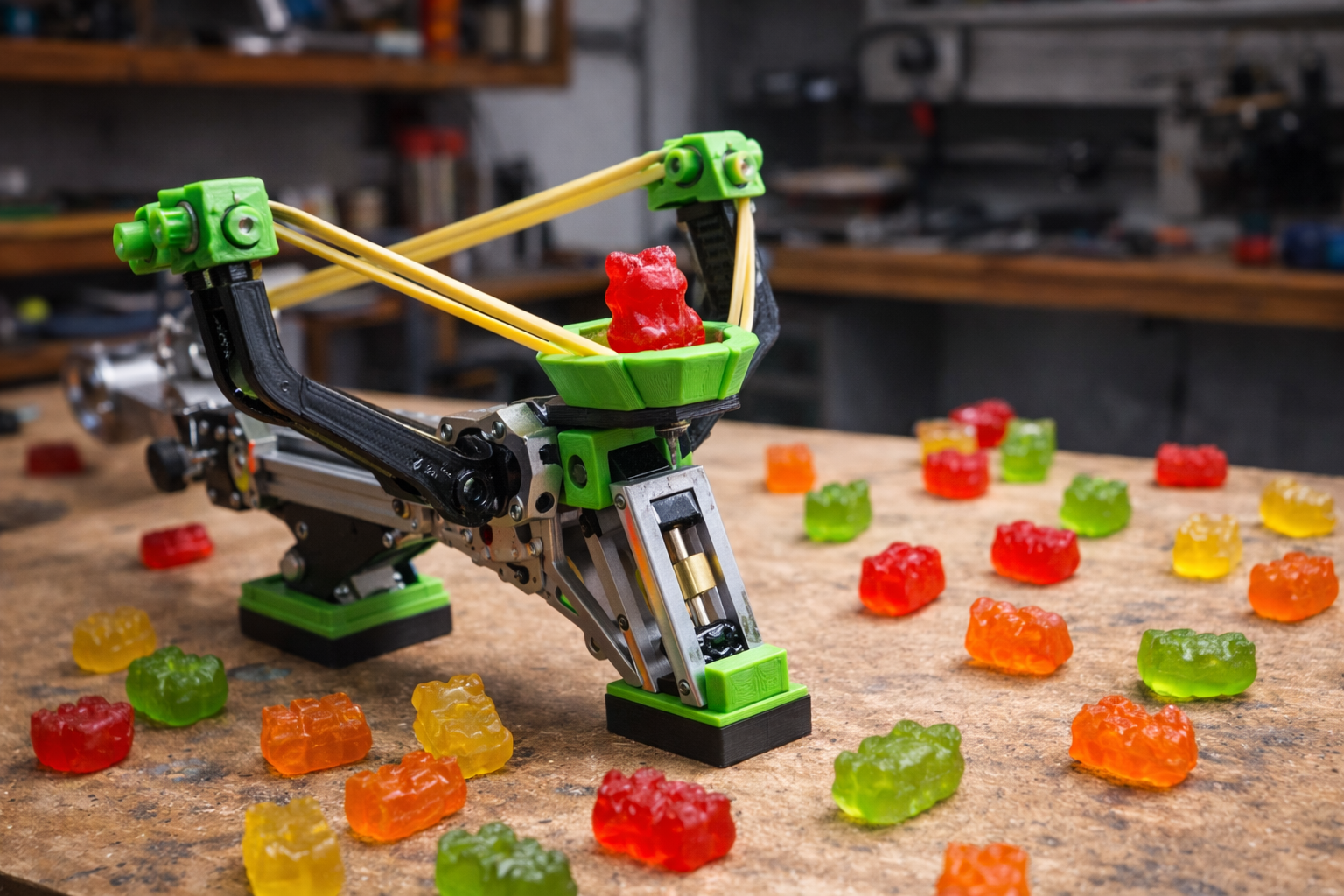
    This gummy bear slingshot is an experimental DIY project for the controlled release of small, soft objects. It was developed as a demonstration object for mechanical principles such as leverage, preload and controlled energy transfer.

    The construction consists mainly of laser-cut wooden parts, an elastic loop and simple connecting elements. All components are designed so that they can be assembled without special tools. The clamping force can be adjusted via the length and position of the elastic bands, allowing different ranges to be tested.

    The focus of the project is not the range, but the reproducible triggering behavior. The slingshot can be triggered individually and enables repeatable test shots under identical conditions. This makes the model particularly suitable for workshops, demonstrations or as an introductory project in the field of simple mechanics.

    The gummy bears only serve as a harmless example object with a defined mass and soft surface. The project is not designed for hard or sharp-edged objects.

    Design files, a parts list and assembly instructions are available for download for this project.

  • Toothbrush cup holder

    Short description

    We design a 3D printed toothbrush cup holder with fully adjustable dimensions. The model is based on a parametric design approach and can be adapted to different cup sizes and mounting conditions. The focus is on practical use and reproducible fabrication.

    How-to project description

    Project goal
    The goal is to create a functional toothbrush cup holder that can be adapted to various cup diameters and clearances without redesigning the model. The holder is intended to be stable, moisture resistant, and suitable for everyday bathroom use.

    Basic idea / concept
    The part is designed as a parametric 3D model. Key dimensions such as cup diameter, wall offset, wall thickness, and holder height are defined as parameters. This allows individual adjustment before printing while keeping the core geometry unchanged.

    Construction / assembly
    The holder consists of a load-bearing base structure with a circular or slightly conical cup interface. Depending on the configuration, mounting can be done using screws and wall plugs or via a flat rear surface for adhesive mounting. Fillets and sufficient wall thickness are used in all load-bearing areas.

    Materials & tools

    • FDM 3D printer
    • Filament such as PETG or ASA for improved moisture resistance
    • CAD software supporting parametric modeling
    • Optional screws, wall plugs, or mounting adhesive
    • Measuring tools for determining cup dimensions

    Implementation notes
    For bathroom environments, we recommend filaments with good resistance to moisture and temperature changes. The print orientation should minimize loads across layer lines. For adhesive mounting, surfaces should be clean and free of grease.

    Conclusion / context
    The parametric toothbrush cup holder is a practical example of functional 3D printing for everyday applications. Its adjustable dimensions make it suitable for personal use as well as for customized variants or small-scale production.